Author V.F.M. FitzSimons With Twelve Colour Plates A. H. Barrat Publisher Collins St James’s Place, London 1st edition 1970 2nd edition 1974 ISBN 0 00 212146 8 Printed in Great Britain Collins Clear Clear-Type Press London and Glasgow Category Field Guide Language English
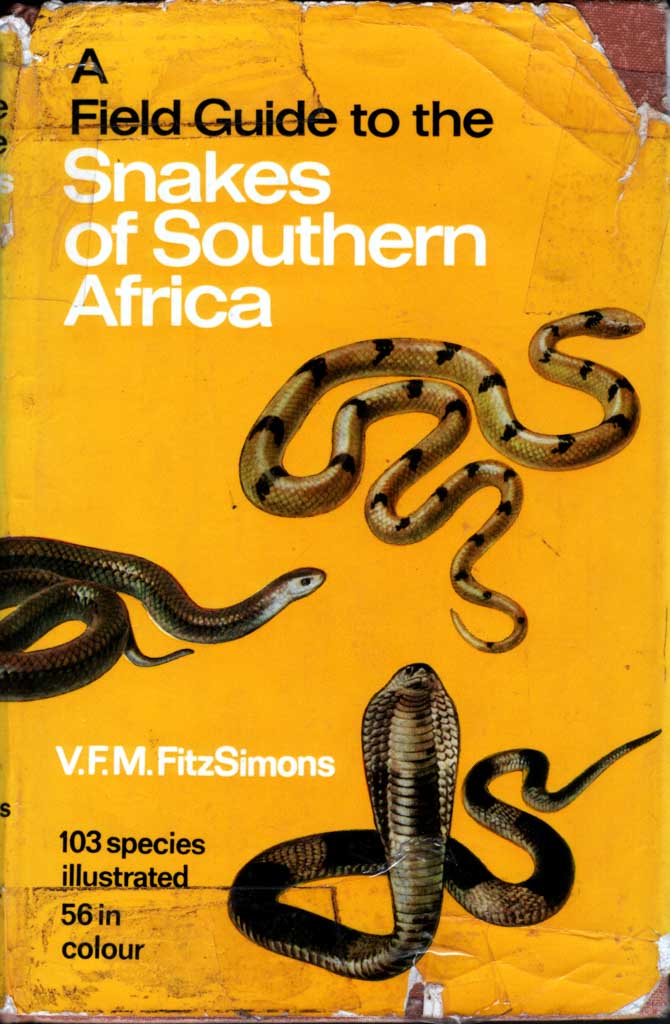
Now completely reset and revised this new edition (1974) includes a summary of the latest research making it the most up-to-date source of information on the snakes of southern Africa.
Coverage. There are 145 species and important subspecies of serpent in southern Africa. Of these, 70 are round only here, 10 extend northwards, 54 are intruders from the north, 3 are widespread throughout Africa, and I, the Black-and-Yellow Sea Snake, is occasionally washed up on the eastern and southern shores. Some 65 are non-venomous, 45 are mildly poisonous and 35 extremely so; but most are useful to man, though persecuted through ignorance and fear.
Description Every snake is fully described, with its English, Afrikaans and scientific names, its shape and length. scale pattern, colouring and distribution within the region. There are notes on all aspects of its frequency, habits or habitats relevant to identification or of particular interest, and in the case of venomous species notes on the type and strength of poison, aggressiveness and method of attack. There is also a concise introduction to snakes and a guide to the different types of snake venom, their effect and the do’s and don’ts in the different cases of snake-bite
Identification On pages 39 to 64 there is a full Key based on colour groupings: yellow, green, grey, brown, black, banded, barred, spotted, speckled or striped.
Illustration The 56 most conspicuous species have been beautifully painted in colour by A. H. Barrett and 38 others are illustrated in photographs.
The author Dr FitzSimons, lately Director of the Transvaal Museum is the world authority on the subject.
‘This guide should do much to enlighten and interest the general public. It offers not only a comprehensive account of each species and a complete key to identification by means of colour markings but a fascinating introduction to the understanding of reptiles and their way of life. The book is invaluable to the expert and layman alike and provides a fascinating reference book for naturalists, farmers and general readers.’
From the archive
Connections
Loading connections…