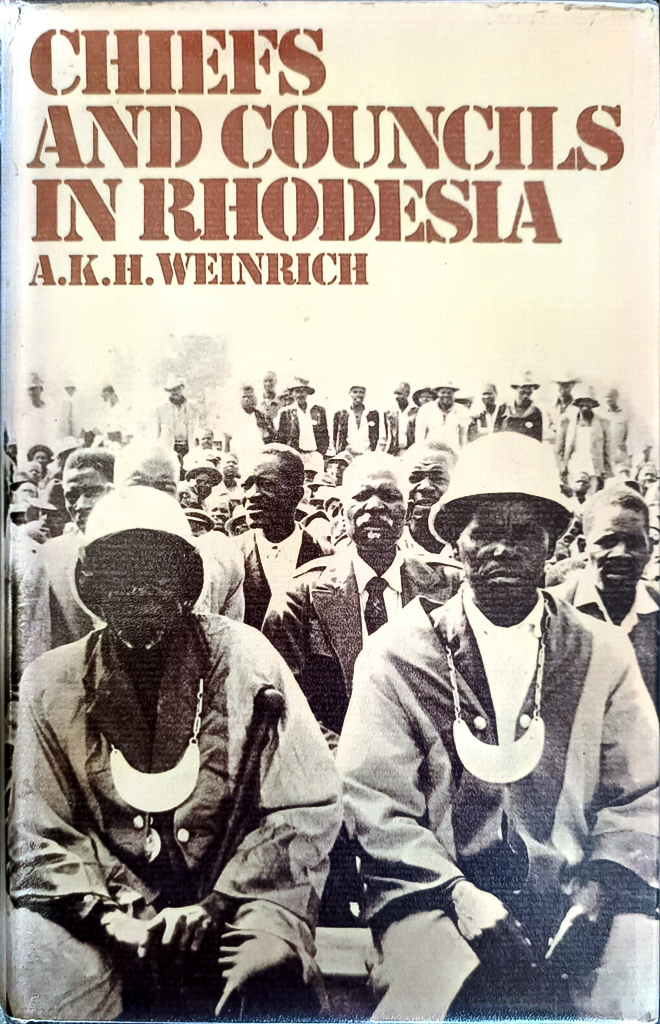
Author A.K.H. Weinrich (Sister Mary Aquina, O.P.) Senior Lecturer in Sociology University of Rhodesia Publisher Heinemann Educational Books Ltd. 48 Charles Street, London WIX 8AH P M B 5205 Ibadan – P O B 25080 Nairobi Edinburgh – Melbourne – Toronto – Auckland – Singapore – Hong Kong – New Delhi SBN 0 435 82918 1 First published 1971 Printed in Great Britain by C. Tinlig & co. Ltd., London and Prescot. Category Sociology Language English

Profile Do chiefs in Rhodesia really command the respect and support of the rural population? Or are they merely government lackeys, tainted by their collaboration with the contentious European administration?
This book is of wide importance. One of the main beliefs of the philosophy of “separate development” (and indeed of apartheid) is that the chiefs are the genuine representatives of the people, even though they have not been democratically elected. This book provides evidence of what the situation really is among one people, the Karanga.
Dr. Weinrich examines the changing position of African chiefs in Rhodesia from 1890 until 1969, especially during the 1960s. The author gives an account of social organization and community structure in a society that is rapidly changing from patriarchalism to bureaucracy. She analyzes the relationship of modern chiefs with their own people and with the European-controlled government, as well as the images that the chiefs have of themselves. Community development has been introduced, but it is suspected that the government is using this policy to implement “separate development.” As a result, the position of the chiefs and other community leaders is being questioned by the people.
Author Profile A. K. H. Weinrich (Sister Mary Aquina, O.P.) is Lecturer in Social Anthropology, University of Rhodesia, Salisbury. She was born in Germany in 1933 and studied at the University of Abitur. In 1954, she joined the Dominican Missionary Sisters in London, whose work is mainly centered in Rwanda and Zambia. She went to Rhodesia in the same year and, after completing her training, taught in many convents and mission schools in Rhodesia and Zambia. She was one of the first graduates of the newly founded University of Rhodesia and Nyasaland in 1959, and from 1960–62 she studied in London and Manchester for her M.A. On her return to Rhodesia in 1965, she became a lecturer at the School of Social Work in Salisbury, and in 1966 she took up her present post.