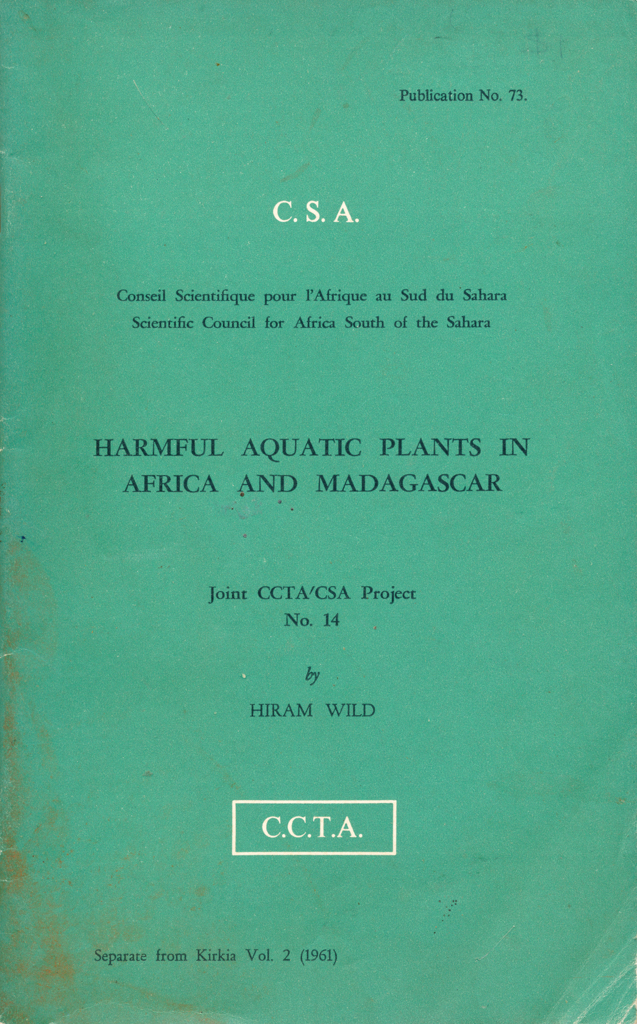
Conseil Scientifique pour l’Afrique au Sud du Sahara | Scientific Council for Africa of the Sahara Publication No. 73 Joint CCTA/CSA Project No.14 Author Hiram Wild Note Separate from Kirkia Vol. 2 (1961) Publication date 1961 Printed by the Government Printer, Salisbury Category Botany Language English/French
COMMISSION FOR TECHNICAL CO-OPERATION IN AFRICA SOUTH OF THE SAHARA (CCTA) SESSIONS
Paris 1950, Brussels 1950, Lisbon 1951, London 1951, Cape Town 1952, Paris
1952, Brussels 1953, Lisbon 1953, London 1954, Paris 1955, Salisbury 1956, Lisbon
1957, Accra 1958, Brussels 1958, Monrovia 1959, Tananarive 1%0, Lagos 1961.
Established in January, 1950, the Commission for Technical Co-operation in
Africa South of the Sahara (CCTA) was the subject of an International Agreement
signed in London on 18 January, 1954. It now consists of the following
Governments: Belgium, Cameroon, Central African Republic, Chad, Congo
(Brazzaville), Congo (Leopoldville), Dahomey, Federation of Rhodesia and Nyasaland,
France, Gabon, Ghana, Guinea, Ivory Coast, Liberia, Madagascar, Mali,
Mauritania, Niger, Nigeria, Portugal, Senegal, Somalia, South Africa, United
Kingdom, Upper Volta.
OBJECT
To ensure technical co-operation between all countries in Africa South of the Sahara.
FUNCTIONS
(1) To concern itself with all matters affecting technical co-operation be tween the Member
Governments and their territories within its territorial scope (Africa South of the 20th
parallel).
(2) To recommend to Member Governments measures for achieving such co-operation.
(3) To ·convene technical conferences as agreed by Member Governments.
(4) To ensure regular exchanges of information through the organizations placed under its aegis.
(5) To promote joint action in the fields chosen by Member Governments, with the assistance of
its Inter-African Research Fund.
(6) To administer the Foundation for Mutual Assistance in Africa South of the Sahara (FAMA).
FINANCE
Contributions from Member Governments to its annual budget.
ORGANIZATION
(1) Full sessions of CCTA are held at least once a year and their recommendations and conclusions
are submitted to Member ·Governments for imple mentation in the territories concerned.
(2) The Scientific Council for Africa South of the Sahara (CSA), Scientific Adviser to CCTA, was
established in Novem ber, 1950, following up on the Johannesburg Scientific Conference (1949),
to further the application of science to the solution of African problems. Its members
are eminent scientists chosen by the Council itself in such a manner that the main scientific
disciplines im important at the present stage of development of Africa shall be represented.
Members of the Council are entirely independent and may not receive instructions from national
authorities.
(3) Technical Bureaux, Committees, Permanent Secretariats and Scientific Correspondents deal with
specific aspects of technical cooperation in Africa South of the Sahara. Some of them work on a
regional basis.
(4) The CCTA/CSA Secretariat has two offices, one in Lagos and one in Nairobi. The Secretariat has
at its head a Secretary-General, who is aided by two Assistant Secretaries-General, a
Scientific Secretary and an Assistant Scientific Secretary. The Secretary-General is also
assisted by the Secretary of FAMA.
PUBLICATIONS
Publications dealing with scientific and technical problems are issued in
London.
From the archive
Connections
Loading connections…