Skip to content

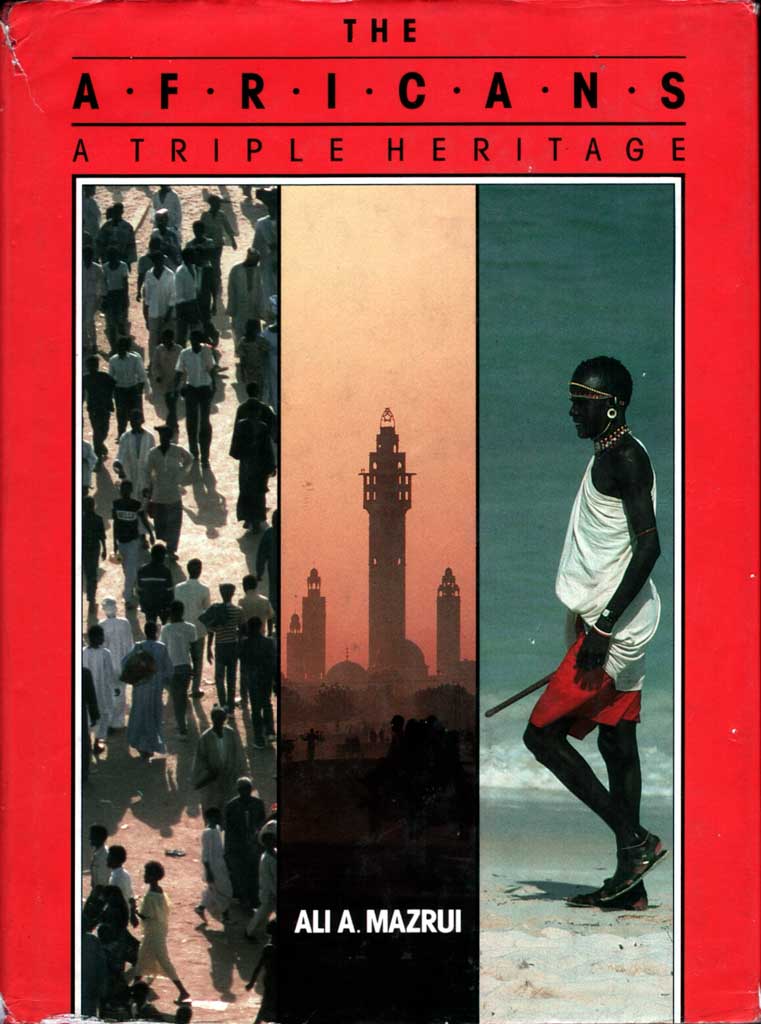
The Africans- A Triple Heritage by Ali A. Mazuri

    Published by BBC Publications A division of BBC Enterprises Ltd 35 Marylebone High Street London W1M 4AA First published 1986 ISBN O 563 20282 3 © Ali A. Mazrui 1986 Set in 11/13pt Melior by August Filmsetting, Haydock , SL Helens Colour separation by Bridge Graphics, Hull
    Printed and bound in the Netherlands by Royal Smeets Off set b.v. Weert Category Africa, Heritage, Culture, Westernization, Islam Language English

    For centuries Europeans regarded Africa merely as a land mass to be circumnavigated on the way to the riches of the Indies. It was the ‘Dark Continent’, the last territory to be fully explored by

    Europeans. Incredibly, it was described as a land without history until the coming of the white man.

    In reality, the African continent has a rich and varied past stretching back over thousands of years. But its story is far more than that of a single indigenous human society, for Africa has a triple heritage of three civilisations which helped to shape it – its own rich inheritance, Islamic culture and the impact of Western traditions and lifestyles. The Africans takes a challenging look at this triple heritage and examines the interplay between these civilisations.

    The images of indigenous Africa are contradictory: the continent encompasses both the rural simplicity of village. We and the sophisticated cultures capable of carrying out such feats of skill

    as the building of the ancient pyramids and Great Zimbabwe. Basic to all African cultures, however, is a close relationship between mankind and nature. The coming of Islam and Westernism has irrevocably distorted this ancient relationship – the introduction of capitalism and the cash economy have produced disastrous results. The African no longer holds nature in awe, he holds it in avarice and profit.

    The influence of the triple heritage is not confined lo the current conflict between mankind and nature, it is present also in the tensions between, city and countryside, between soldiers and politicians, between the elite and the masses between the religious and the secular, between a longing for autonomy and the shackles of dependence upon imported cultures.

    Africa is at a crucial stage in its history as it is torn between cultures. Is the decay

    of Africa’s colonial institutions a ‘curse of the ancestors’ pronounced upon the compact which Westernised Africans have made with the twentieth century?

    The Africans examines the soul of a continent – a soul which is at present split three ways.